

The best time to post on Instagram in 2026 is when YOUR specific audience is most active — check Instagram Insights → Audience for your peak times. Globally, Tuesday-Thursday evenings (6-9pm in your audience timezone) work for most niches, with secondary peaks at lunch (12-1pm) and morning (7-9am). Consistency beats “perfect time”: pick a window and stick to it.
⚡ Key takeaways
- Use YOUR Insights data, not generic charts — audiences differ.
- Globally: Tue-Thu evenings (6-9pm audience local time) is the strongest window.
- Three daily peaks: morning, lunch, evening. Test which works for you.
- Post in your AUDIENCE’s timezone, not your own.
- Consistency beats “perfect time” — same time slot every week wins.
Use your own audience data first
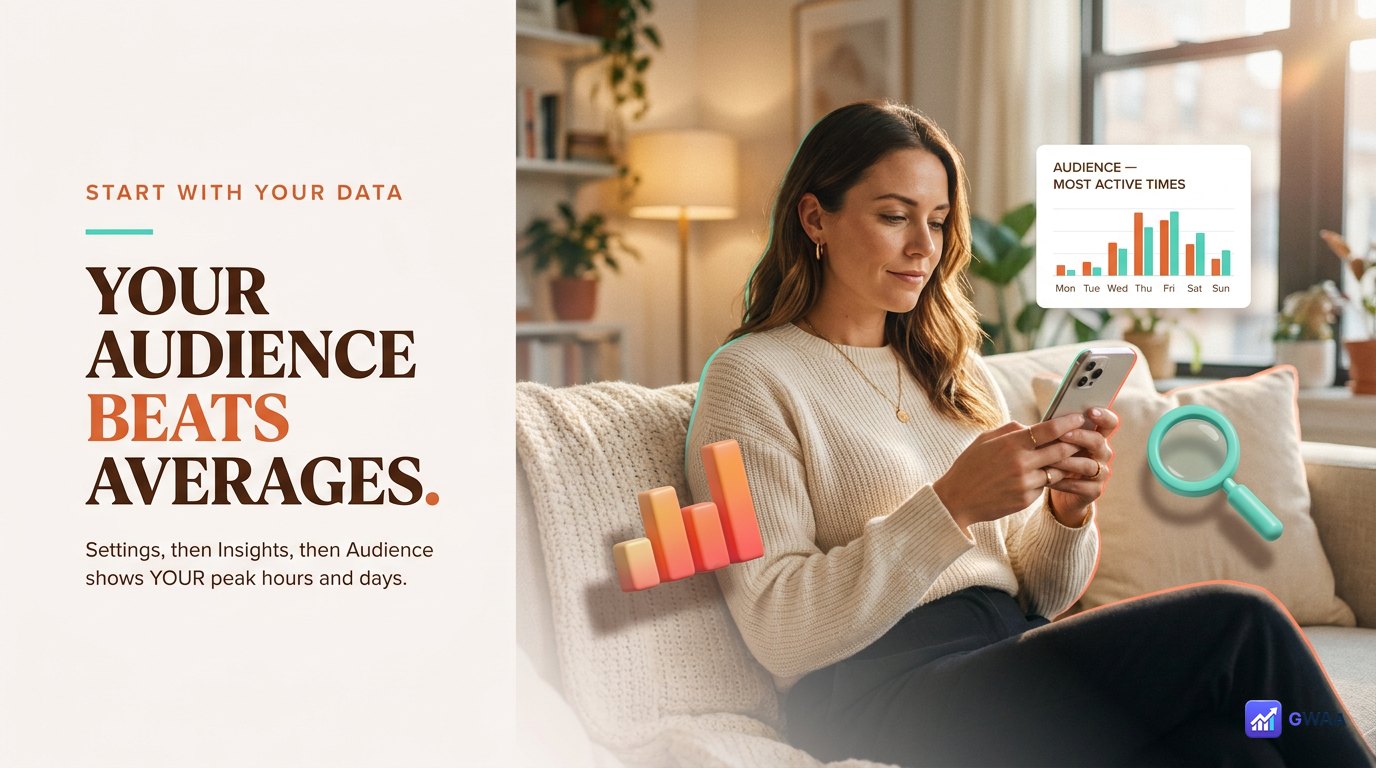
Before any general advice, get the data Instagram already has on your audience. If you have a business or creator account, open the app, go to Settings → Insights → Audience, and scroll to “Most Active Times”. Two charts:
- Hourly: Shows when your followers are most active during the day. There are usually 2-3 distinct peaks.
- Daily: Shows which days your followers are most engaged. Patterns vary wildly by niche.
This data beats every “best time to post” chart on the internet because it’s specific to your audience. A fitness account’s audience peaks differ from a food account’s. A US-focused audience peaks differ from a global one. Use the chart, not the average.
If you have a personal account, switch to a free Creator account for 30 days to access Insights, then switch back if you prefer. The Insights data alone is worth the temporary switch.
Global averages for 2026
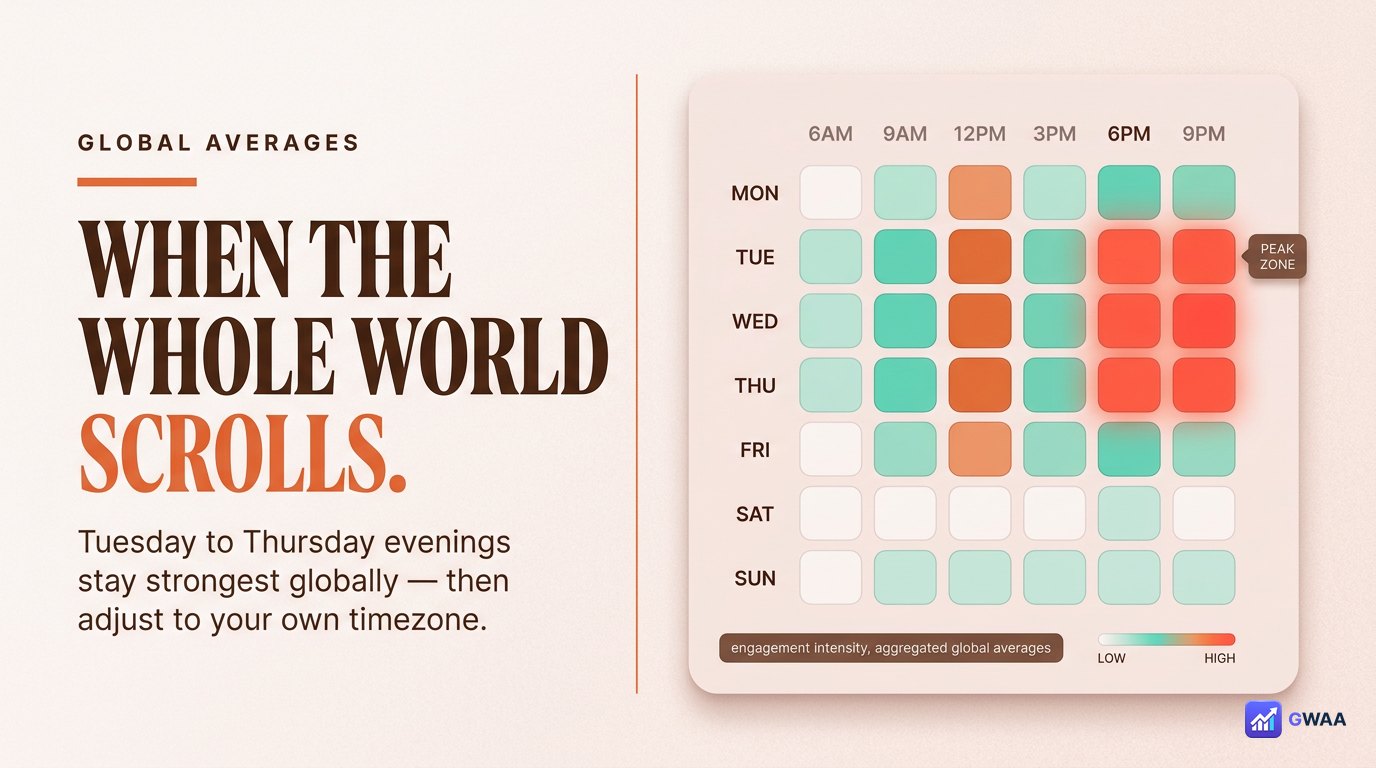
If you can’t access your own Insights yet, start with these 2026 global averages. They’re based on aggregated studies of millions of posts:
- Best window overall: Tuesday-Thursday, 6-9pm in your audience’s local timezone.
- Secondary peaks: Lunch (12-1pm) and morning (7-9am).
- Worst window: Late night (10pm-6am) and weekend afternoons.
These are starting points only. Within 4 weeks of consistent posting, your own Insights will give you better data, and you should switch to that.
Best days to post
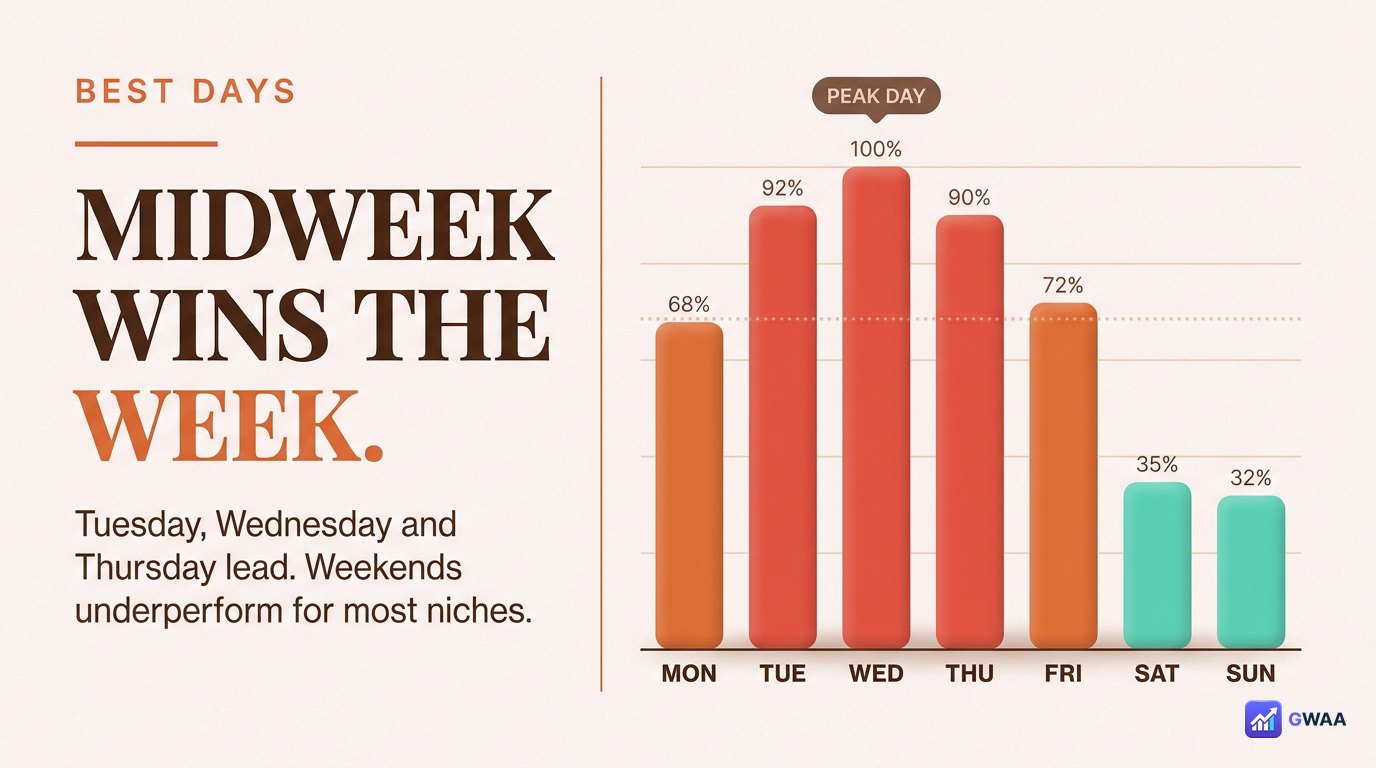
Weekday breakdown for typical engagement:
- Tuesday: Often the single best day. Audiences are settled into the week, looking for content.
- Wednesday: Mid-week peak. Very strong for most niches.
- Thursday: Strong, especially evenings as people anticipate the weekend.
- Monday: Mixed. Strong for B2B and educational content, weaker for lifestyle.
- Friday: Drops off by evening as people switch to weekend mode.
- Saturday-Sunday: Generally weakest. People are away from phones, with families, etc.
Two exceptions to the weekend rule: food (Sunday brunch posts perform well) and travel (Sunday escapism content engages well). Most other niches see weekend drops.
Three daily peaks
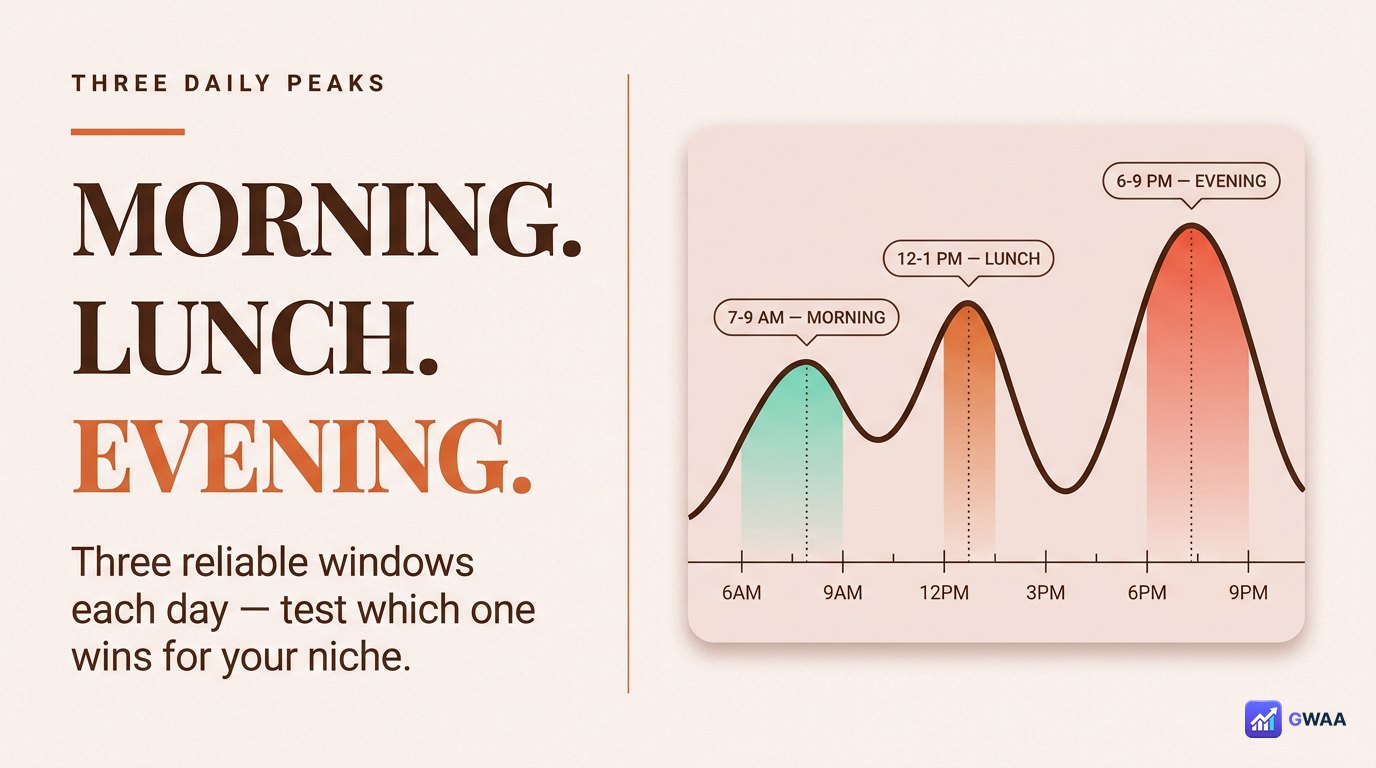
Within any given day, three time windows show consistent peak engagement:
- Morning (7-9am): Commute and early-day scroll. Works for inspirational, news, fitness content.
- Lunch (12-1pm): Quick mid-day break. Works for shorter-form content (reels, single images, quick tips).
- Evening (6-9pm): The strongest window for most niches. People are home, relaxed, scrolling. Works for everything.
For most accounts, evening is the highest-priority window. If you only have time to optimise for one slot, make it Tuesday-Thursday between 6-9pm in your audience timezone.
By niche — the variations
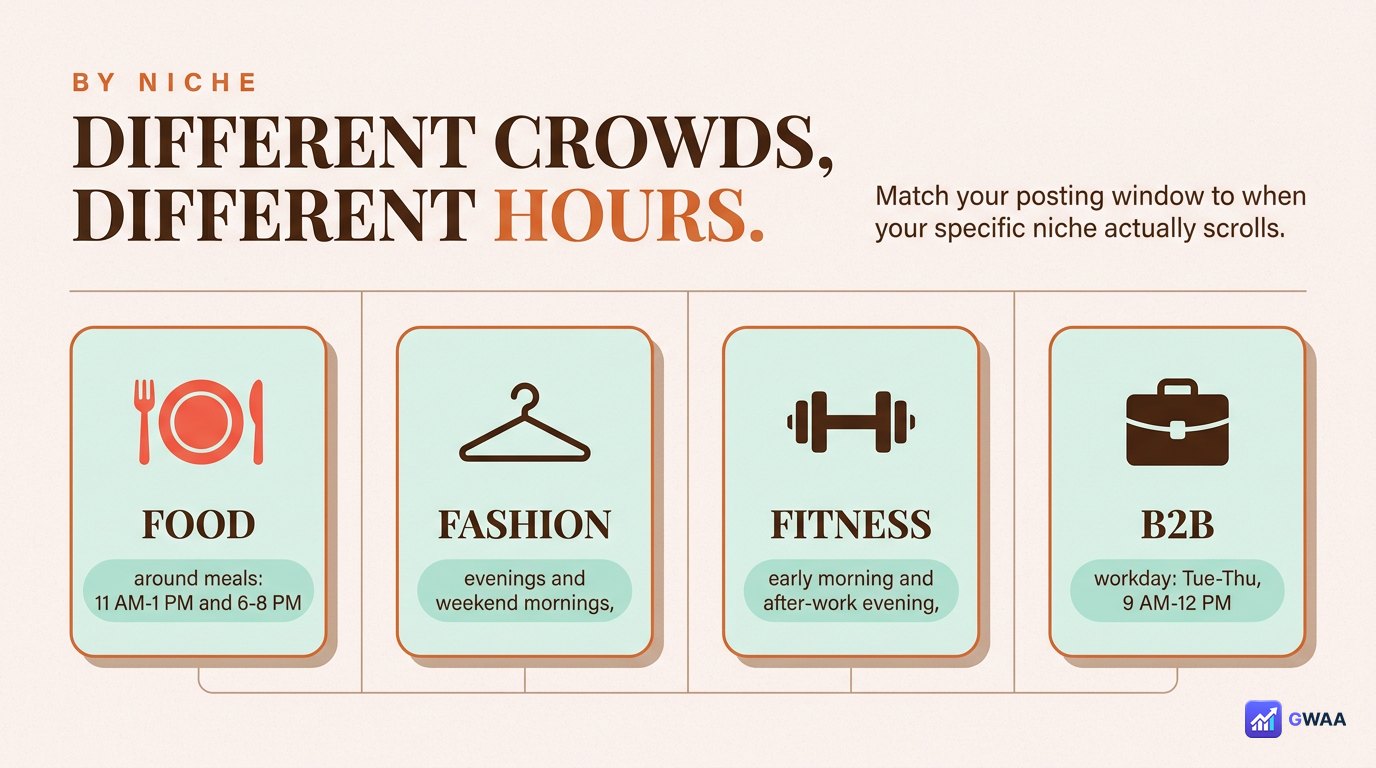
Niche-specific patterns:
- Food & recipes: Lunch (12pm) and dinner prep (5-6pm) hit hardest. Sunday brunch (10-11am) is a hidden peak.
- Fashion & beauty: Evening (7-9pm) when people scroll for inspiration before bed.
- Fitness: Two peaks — morning (6-8am, pre-workout audience) and evening (6pm, post-workout audience).
- Travel: Sunday evenings (escapism for the workweek ahead) and Friday afternoons.
- B2B / business: Tuesday-Thursday 9am-11am or 1-3pm (workday windows).
- Lifestyle / personal: Evening 7-9pm, weekdays. Avoid weekends.
- Education / how-to: Sunday-Tuesday, late evening (8-10pm) when people plan their week.
If your niche isn’t listed, find an adjacent one and start there.
Post in your audience timezone
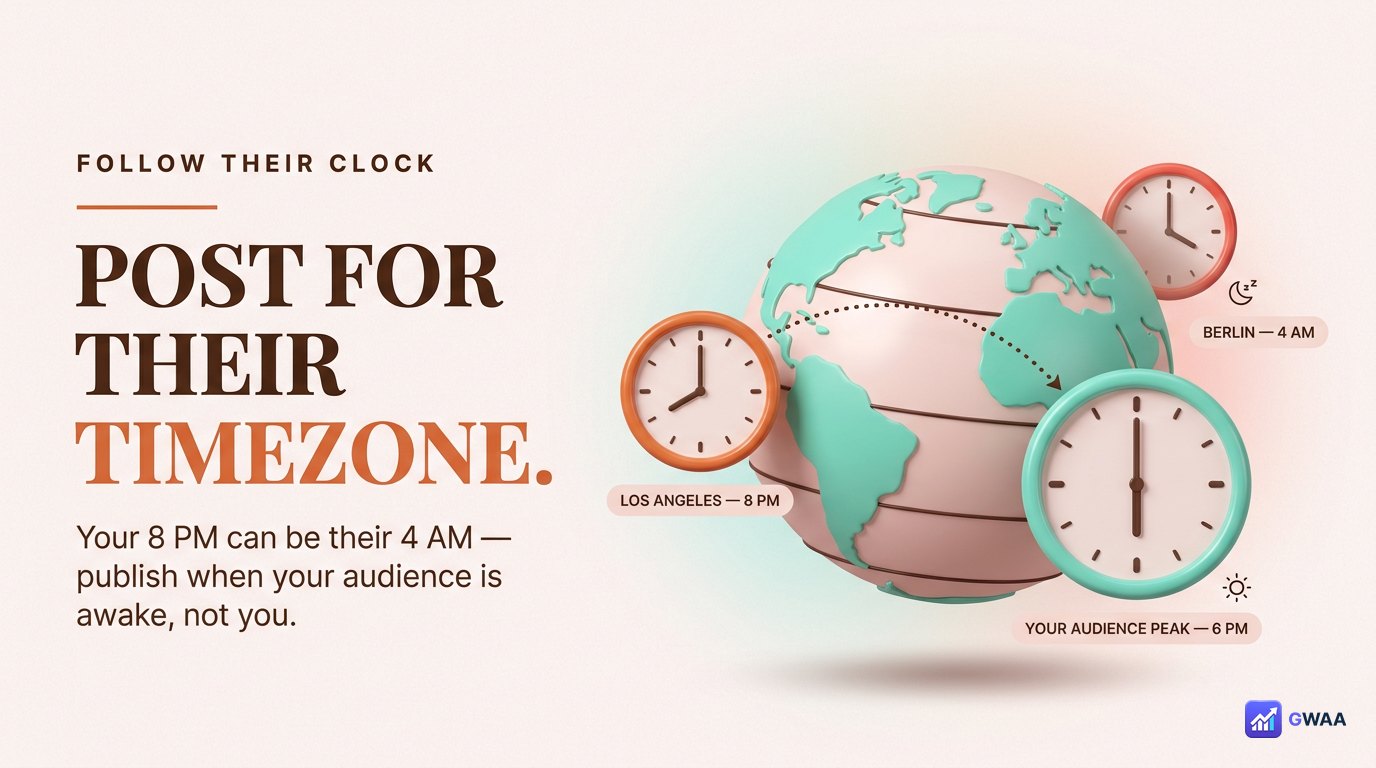
One of the most common posting mistakes: posting at your local time instead of your audience’s. If you live in Los Angeles but your audience is mostly in Europe, your 8pm post hits at 4am for them — the worst possible time.
How to handle this:
- Check Audience Location in Insights. Settings → Insights → Audience shows the top countries and cities of your followers.
- Identify the dominant timezone. If 60%+ of your audience is in one region, post in that region’s peak hours.
- Use a scheduler. Instagram Preview, Later, Buffer, or Meta Business Suite all schedule posts to fire automatically at the right time.
Consistency beats “perfect time”
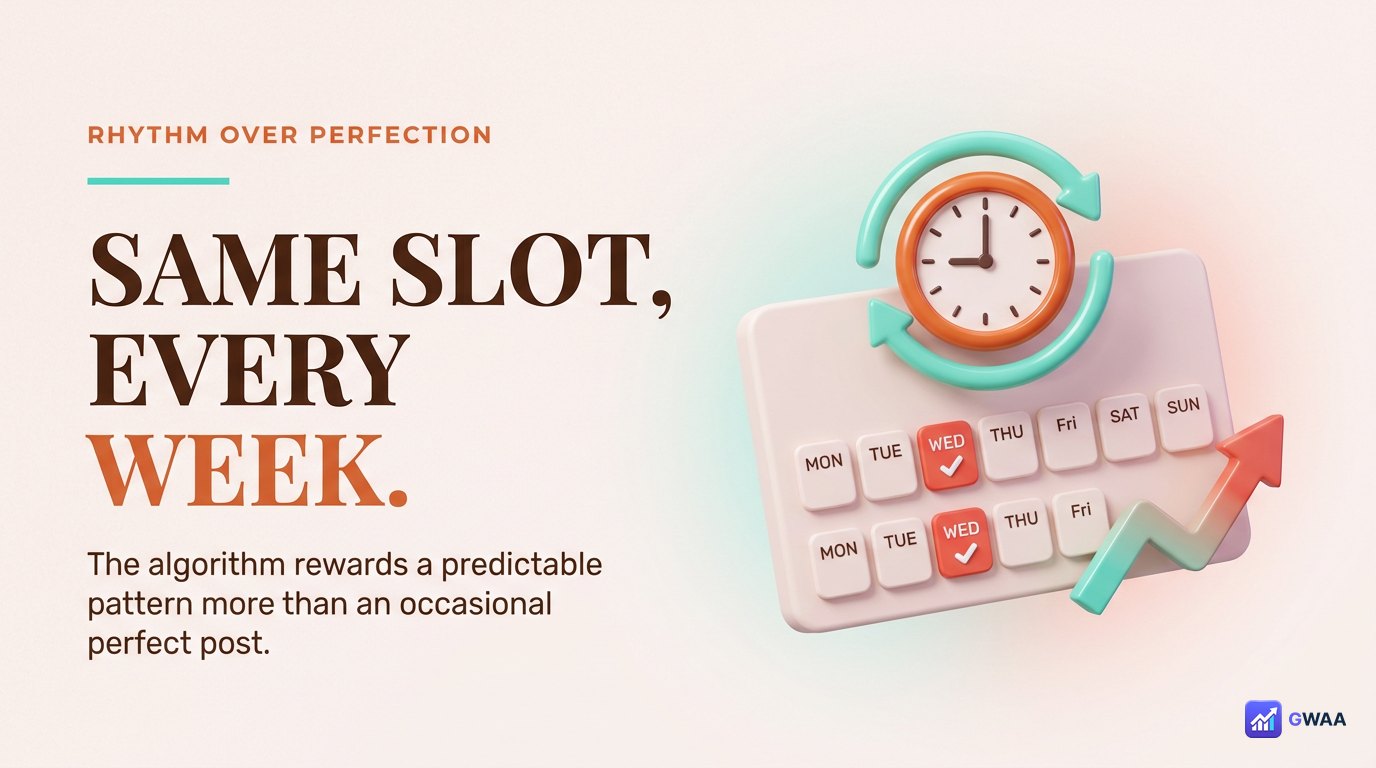
Counter-intuitive but well-documented: posting at the SAME time consistently outperforms posting at the “perfect” time inconsistently. The algorithm rewards predictable posting patterns because:
- Your audience learns when to expect content from you and tunes in.
- The algorithm flags “active accounts” and prioritises them.
- Engagement timing data accumulates better, helping Instagram serve your content to similar users.
So: pick a window (Tuesday-Thursday 7pm, say), commit to posting in that window every week for 4 weeks, then evaluate. Consistency at 80% accuracy beats perfect timing at 30% accuracy.
How to find YOUR best time in three weeks
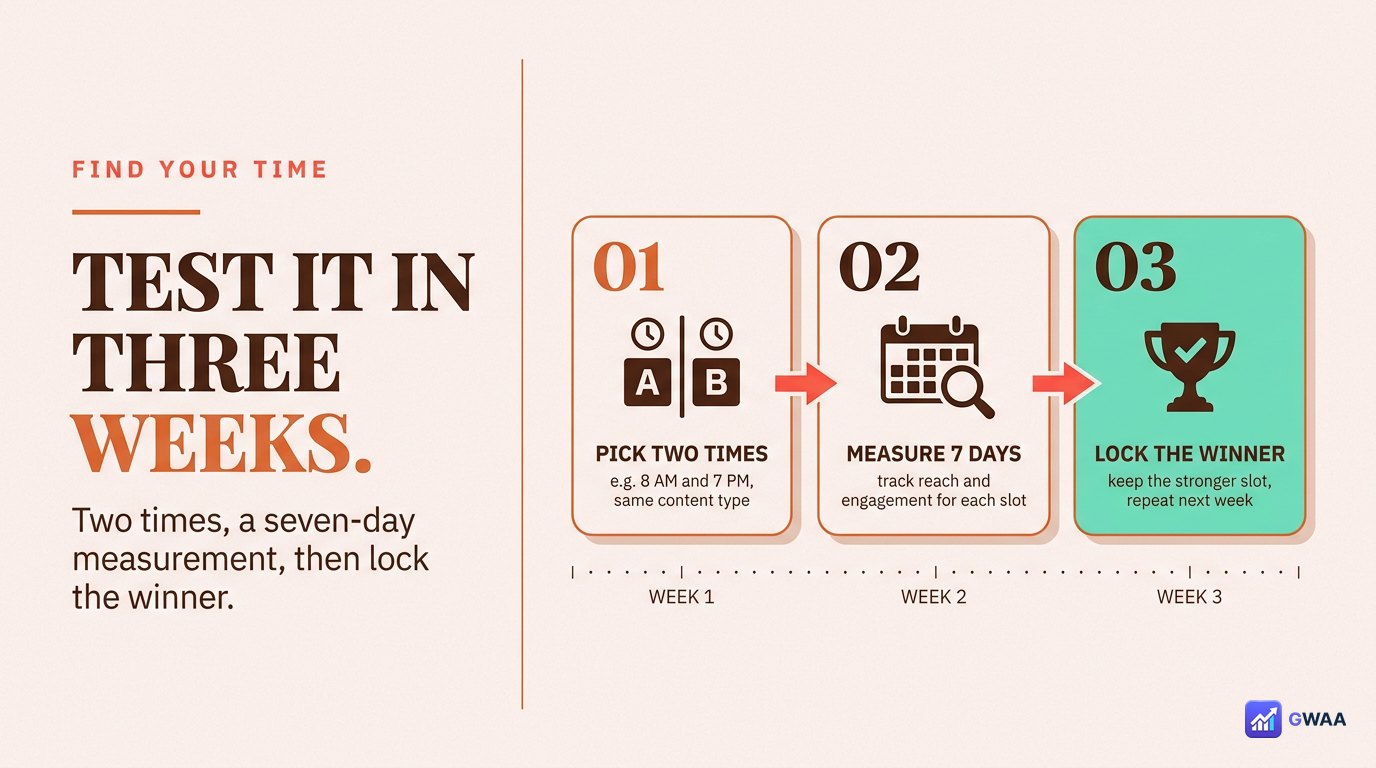
Run a simple A/B test:
- Week 1: Post all content at time A (e.g., Tuesday 7pm).
- Week 2: Post all content at time B (e.g., Thursday 8pm).
- Week 3: Compare engagement metrics (reach, likes, comments) between week 1 and week 2. Lock in the winner.
Be specific: same content quality, same caption format, same hashtag count. The only variable should be the posting time. After 3-4 cycles like this, you’ll have a reliable winner.
Scheduling tools that help
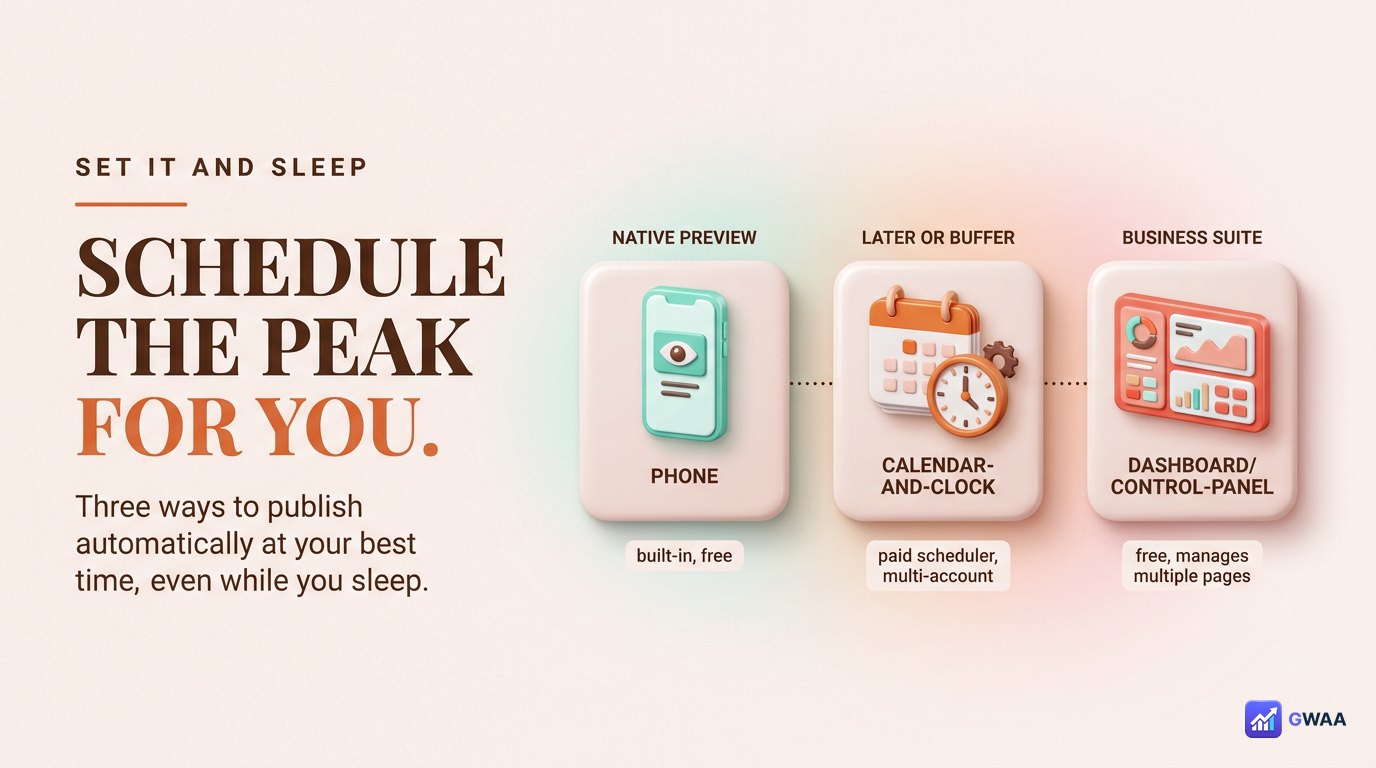
Once you know your best time, scheduling tools let you post automatically at peak times even when you’re asleep or unavailable:
- Instagram’s native scheduling: Built into the app for business/creator accounts. Free. Sufficient for most users.
- Meta Business Suite: Web-based, more features, supports both Instagram and Facebook scheduling. Free.
- Later / Buffer / Hootsuite: Paid third-party schedulers with better analytics, content libraries, team collaboration. Worth it if you manage multiple accounts.
Native scheduling is enough for personal use. Paid tools matter once you’re juggling 3+ accounts or working with a team.
Three persistent “best time” myths
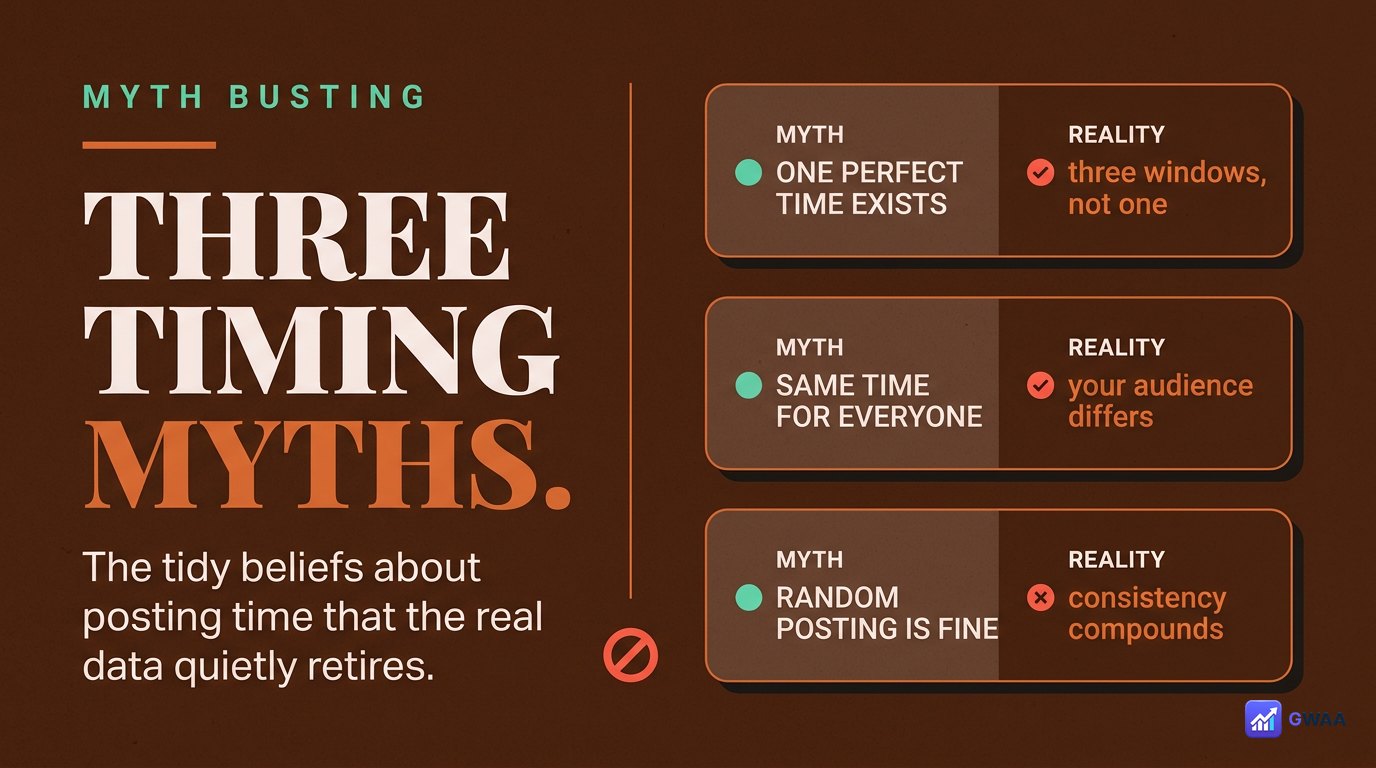
Three myths still floating around 2026:
- Myth 1: “There’s one perfect time for everyone” — Wrong. Three daily windows, each works for different niches.
- Myth 2: “Posting at random times works fine” — Wrong. Algorithm rewards consistency. Random posting underperforms.
- Myth 3: “The same chart from 2020 still applies” — Wrong. Instagram’s algorithm evolves. Always use current data (your Insights or fresh 2026 studies).
Day-by-day breakdown with reasoning
If you’re curious why the weekday/weekend split looks the way it does, here’s the practical reasoning:
- Monday: The week is starting. People are at work or commuting, busy with the week ahead. Most users haven’t settled into “scroll mode” yet. Strong for B2B and educational content because professionals are checking feeds; weaker for lifestyle/entertainment.
- Tuesday: Audiences have settled into the week. Evening commute and dinner-time scrolling are at peak engagement. Tuesday is often the single best day overall.
- Wednesday: Mid-week peak. Audiences are most engaged because the workweek is half over and they’re looking for distraction.
- Thursday: Continued strong, especially evenings as people anticipate Friday and weekend plans.
- Friday: Strong morning and lunch, drops sharply after 5pm as people switch to weekend activities (drinks, dinners, social plans).
- Saturday: Generally lowest engagement. People are out, with family, or doing things rather than scrolling.
- Sunday: Picks back up in the evening as people prepare for the week ahead. Sunday 6-9pm is a hidden secondary peak for many niches.
When the global rules don’t apply
Several niches and audience types break the standard patterns:
- Global audiences across many timezones. If your audience is spread evenly across multiple regions, there’s no clean peak — you have rolling 6-9pm windows in different countries. Posting at multiple times per week or using strategic scheduling becomes more important than picking one optimal slot.
- Niche audiences with unusual rhythms. Night-shift workers, parents of newborns, students — their peak times differ from working professionals. If your audience is dominated by an unusual demographic, their schedule overrides general averages.
- Event-driven content. Sports commentary, breaking news, conference live-tweeting — these have their own timing rules. Post when the event is happening, regardless of general best-time charts.
- Time-sensitive content. Morning routines need to post in the early morning, evening recipes need to land at 5-6pm. Match the content’s natural time to the posting time.
Frequency matters too, not just timing
One thing that gets lost in “best time to post” discussions: how often you post matters as much as when. The interaction:
- Posting more often (5+ per week) = more chances to hit the algorithm right, but each post gets less attention because you’re competing with yourself for follower attention.
- Posting less often (1-2 per week) = each post gets full attention, but you have fewer at-bats with the algorithm.
- 3-5 per week = the sweet spot for most niches. Enough volume to give the algorithm signal, not so much that you cannibalise yourself.
Within that 3-5 range, posting at your best time slot consistently outperforms posting at random times more frequently.
Different formats want different times
One subtle pattern: different content formats have slightly different optimal times.
- Reels: Best in the evening (7-10pm). Reels are primarily entertainment; people watch them when relaxing.
- Carousels: Best in the morning (8-10am) and lunch (12-1pm). Carousels are educational/informational; people consume them with active attention.
- Single image posts: Flexible, but follow the same evening pattern as reels.
- Stories: Throughout the day, but always in your audience’s peak hours. Stories disappear in 24h so timing matters more than for permanent content.
Building a weekly posting routine
Beyond knowing your best time, building a sustainable weekly rhythm reduces the cognitive load and improves consistency. A workable template:
- Sunday afternoon: Plan the week. Pick 3-5 posts, draft captions.
- Monday-Friday at your peak time: Post automatically via scheduler.
- 15 min after each post: Reply to comments, react to DMs.
- Daily stories: 1-3 stories spread through the day, no scheduling needed.
This routine takes about 90 minutes of focused work per week (Sunday planning) plus 15-30 minutes of daily engagement. Much more sustainable than trying to be reactive and posting whenever you feel like it.
The 4-step playbook
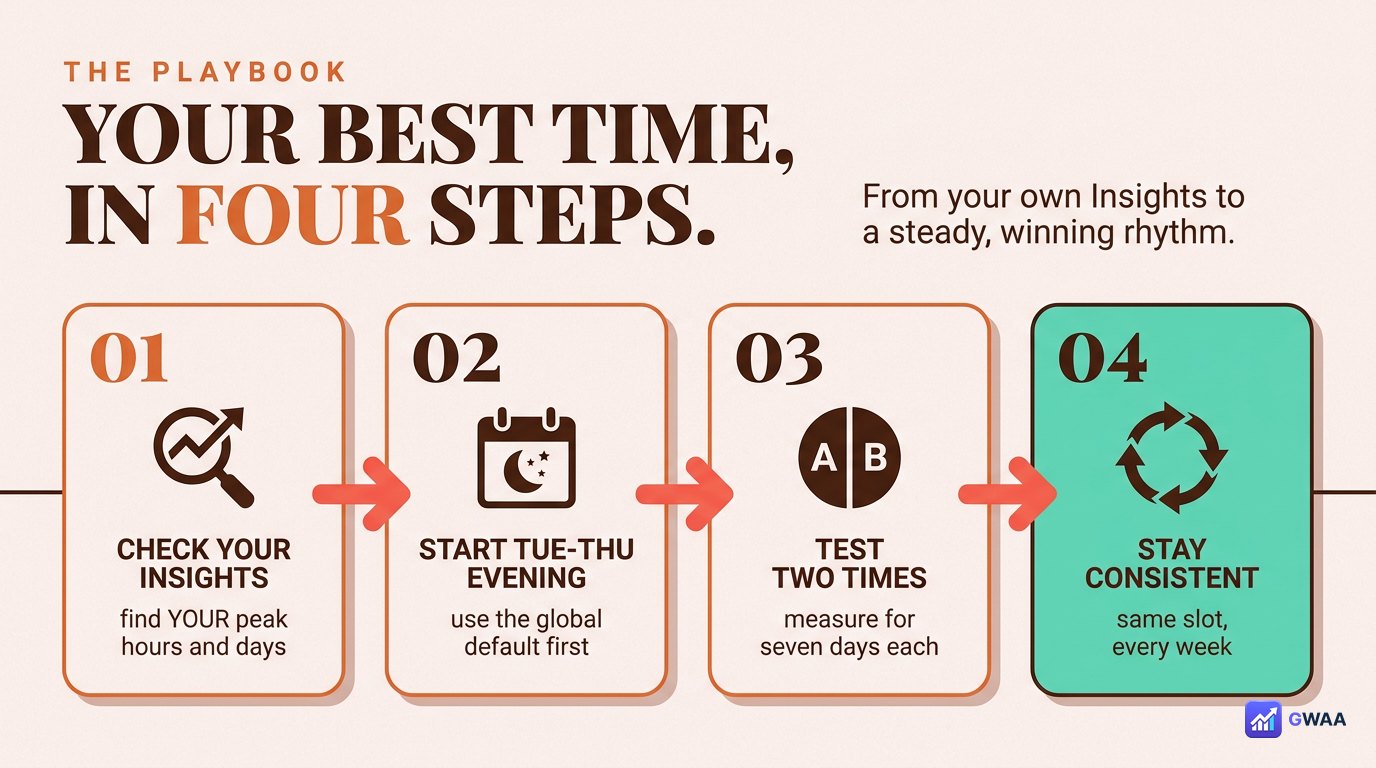
The whole playbook in four steps:
- Check YOUR Insights (or start with Tuesday-Thursday evenings if you don’t have data yet).
- Post in your audience’s timezone, not your own.
- Run a 3-week A/B test between two times to find your winner.
- Lock the winner and post consistently in that slot for at least 3 months.
That’s it. The “best time to post” isn’t a fixed answer — it’s a process of discovering your specific audience’s peak and then disciplining yourself to post there consistently. Most accounts overthink this and underexecute the consistency part. Get the timing roughly right (Tuesday-Thursday evenings is a strong default), then focus the rest of your energy on content quality and posting reliably. Those two compounds are what build long-term reach.
Explore more across GWAA: Profile analytics explained · Spot a fake account